
Article: How to Identify a Genuine Handloom Banarasi Saree
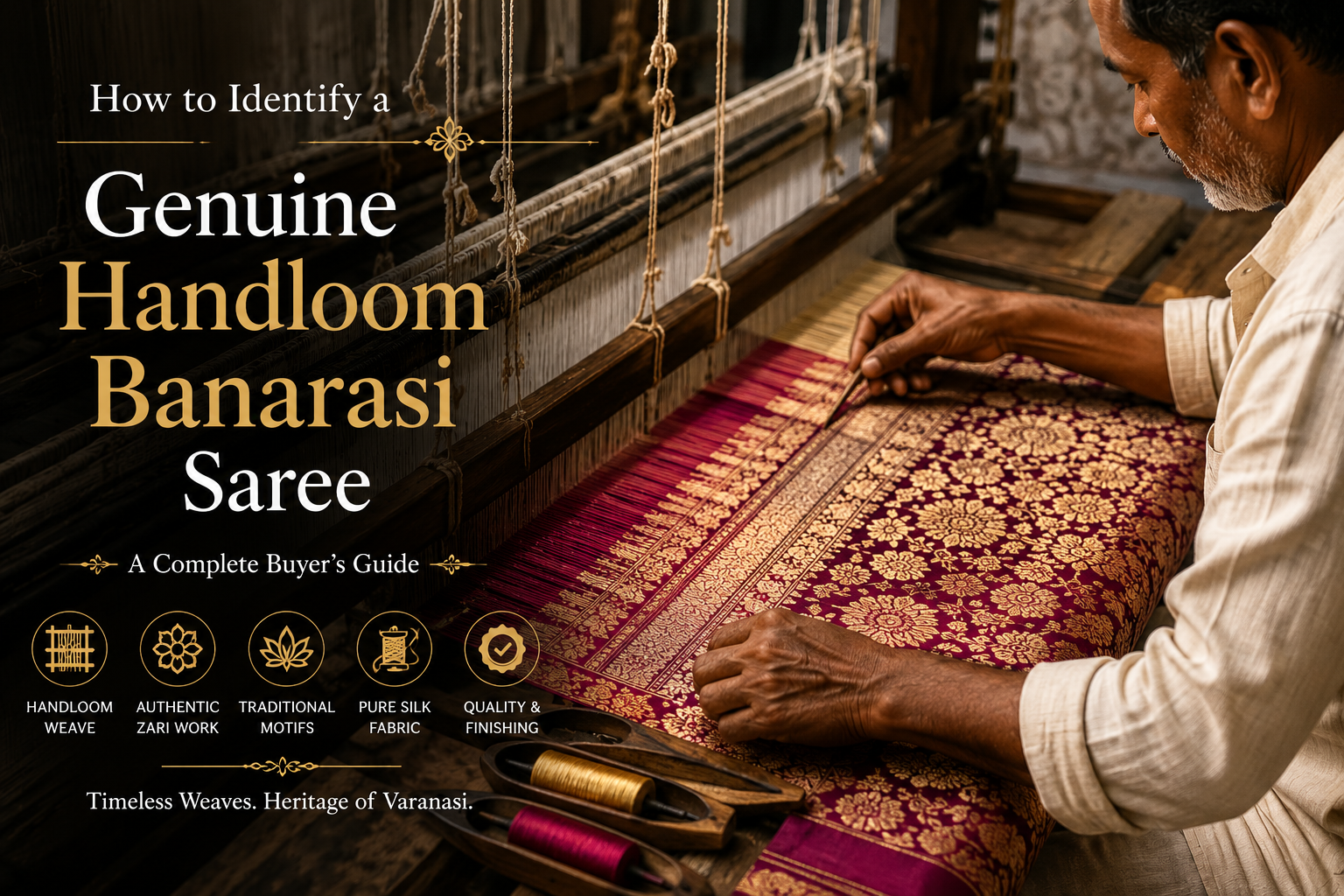
How to Identify a Genuine Handloom Banarasi Saree
A Banarasi saree is much more than an elegant piece of Indian clothing. Woven in and around Varanasi, it represents centuries of textile craftsmanship, intricate design and the skill of generations of weavers. Banaras Brocades and Sarees are also a registered Geographical Indication product, with traditional Banarasi weaving known for finely woven fabrics, zari work, floral and foliate motifs, jali patterns and meenakari. (Varanasi District)
With Banarasi-inspired sarees now available in many fabrics and price ranges, however, it can be difficult for a buyer to distinguish a genuine handloom saree from a machine-made or powerloom product.
If you are planning to invest in a Banarasi saree, here are some practical things to check before buying.
1. Look for the Handloom Mark
One of the best places to start is the Handloom Mark.
The Government of India’s Handloom Mark scheme provides a collective identity for genuine handwoven products. Genuine Handloom Mark labels carry a unique QR code that can be scanned to verify information associated with the handwoven product and its weaver. (Handloom Mark)
When buying an expensive handloom Banarasi saree, ask the seller whether the product carries a valid Handloom Mark label.
However, certification should be considered together with the saree’s fabric, weaving, design and seller information rather than relying on one feature alone.
2. Examine the Reverse Side
Turn the saree over and carefully inspect the back.
The reverse side can reveal useful information about how the motifs and zari have been woven. Handwoven textiles can show subtle variations resulting from the artisan-controlled weaving process.
Look closely at areas containing dense zari or complicated motifs. The construction should look like an integral part of the fabric rather than a surface design.
At the same time, don’t assume that every visible thread or variation proves that a saree is handloom. Different Banarasi weaving techniques can produce different reverse-side appearances, so this should be treated as one clue rather than a standalone authenticity test.
3. Examine the Zari Work
Zari is one of the most recognisable features of traditional Banarasi sarees.
Traditional Banarasi weaving is particularly associated with intricate zari decoration and detailed motifs. Government information on Banaras Brocades and Sarees highlights features including floral and foliate designs, kalga, bel, compact weaving, metallic effects, jali and meenakari work. (Varanasi District)
When examining a saree, look closely at:
* The definition of the zari motifs
* The consistency of the woven pattern
* The relationship between zari and silk
* The finishing of the border and pallu
* Whether the design appears woven rather than simply printed
Remember that a shiny gold appearance by itself does not prove that a saree is handloom. The weaving technique and material should also be verified.
4. Learn the Traditional Banarasi Motifs
Knowing traditional Banarasi designs can make shopping much easier.
Some commonly recognised motifs include:
Butidar: Small repeated motifs distributed across the saree.
Booti: A small decorative motif.
Boota: A larger decorative motif.
Jangla: A dense pattern of floral and vine elements.
Bel: A decorative creeper or vine design.
Kalga: A traditional floral-inspired motif often seen in elaborate Banarasi designs.
Shikargah: Elaborate designs depicting birds, animals, trees and other elements of nature.
These motifs are part of the rich design vocabulary associated with Banarasi textiles.
5. Check the Fabric
Not every Banarasi saree feels the same.
Banarasi sarees are available in different fabrics and constructions, including silk varieties, organza, georgette and other textile blends. The weight, softness, sheen and drape can therefore vary significantly.
A genuine handloom Banarasi does not necessarily have to be extremely heavy.
A saree with elaborate zari and dense motifs may feel heavier, while a more delicate design can be lightweight and graceful.
Before purchasing, always check the product description for the exact fabric composition rather than relying only on how the saree feels.
6. Carefully Inspect the Pallu
The pallu is one of the most important visual elements of a Banarasi saree.
Look at the detailing, zari work and overall construction. Traditional Banarasi sarees often feature elaborate pallu designs that complement the body and border.
If you are buying online, don’t rely on a single full-length photograph. Look for close-up images of the:
* Pallu
* Border
* Body
* Zari work
* Weaving details
High-resolution photographs can make it much easier to evaluate a saree before purchasing.
7. Examine the Border
The border is another useful area to inspect.
Traditional Banarasi borders can feature floral, geometric, vine and zari patterns. Look closely at whether the motifs are clearly defined and properly integrated into the fabric.
Ask yourself:
Is the design woven or printed?
Does the zari have a refined finish?
Is the border neatly constructed?
Does the pattern continue consistently along the saree?
These observations can help you understand the quality of the weaving.
8. Ask the Seller Direct Questions
One of the easiest ways to avoid confusion is to ask specific questions before buying.
Instead of simply asking, “Is this a Banarasi saree?”, ask:
* Is it handloom or powerloom?
* What is the exact fabric?
* Where was it woven?
* What type of zari is used?
* Is the design woven or printed?
* Does it carry a Handloom Mark?
* Can you provide close-up photographs?
* What are the care instructions?
A transparent seller should be comfortable explaining the construction and materials of the saree.
9. Understand Handloom vs Powerloom
The difference between handloom and powerloom is important.
A handloom Banarasi saree is woven on a handloom using traditional weaving processes and artisan skill. Banarasi sarees are traditionally woven on conventional Banaras handloom jacquard systems, with attachments such as jala, pagia and naka used for creating motifs. (Varanasi District)
A powerloom saree, on the other hand, is produced using mechanised weaving equipment.
A powerloom saree is not automatically a bad-quality saree. It can be attractive, durable and affordable. The important point is honest product description.
If a powerloom saree is being sold, it should not be represented as handloom.
10. Don’t Judge Authenticity by Price Alone
Price is another area where buyers can easily become confused.
A high price does not automatically mean that a saree is handloom, and a lower price does not automatically mean that it is fake.
The price can depend on:
* Fabric
* Zari quality
* Weaving complexity
* Design density
* Artisan workmanship
* Time required for production
* Finishing
* Brand and retail costs
A simpler handloom saree may cost less than a highly elaborate saree containing extensive zari work.
Therefore, consider fabric + weaving + zari + craftsmanship + certification + seller transparency together.
11. Look for a Transparent and Trustworthy Seller
A reliable seller should clearly communicate what you are purchasing.
Ideally, the product information should mention:
Fabric: What the saree is made from.
Weave: Whether it is handloom or another weaving method.
Zari: The type and quality of zari used.
Design: The traditional or contemporary weaving style.
Origin: Relevant information about where it was produced.
Care: Instructions for maintaining the saree.
At BanarasiHub, we believe customers should be able to make an informed decision when purchasing a saree. Clear product descriptions and detailed photographs are especially important when buying online.
12. Don’t Treat Every Small Variation as a Defect
Handwoven textiles can have subtle variations because they are created through an artisan-led process.
You may occasionally notice slight differences in texture, motif placement or weaving tension.
These characteristics can be part of the individuality of a handwoven textile.
However, major damage, stains, holes or significant structural problems should never simply be dismissed as “handloom characteristics.” A responsible seller should clearly disclose genuine defects.
Quick Checklist Before Buying a Handloom Banarasi Saree
Before making your purchase, check:
* Handloom status: Is the saree genuinely handwoven?
* Handloom Mark: Is an appropriate label available?
* Fabric: What is the exact material?
* Zari: What type of zari is used?
* Motifs: Are the designs woven into the fabric?
* Reverse side: Have you inspected the construction?
* Pallu: Is the finishing and zari work detailed?
* Border: Does it have clean and consistent weaving?
* Seller: Is the product information transparent?
* Price: Does the price make sense for the materials and craftsmanship?
Final Thoughts
Identifying a genuine handloom Banarasi saree is not about relying on a single test. The best approach is to examine several factors together—the weave, fabric, zari, motifs, border, pallu, finishing, certification and seller transparency.
The Handloom Mark can provide an important additional layer of confidence, while the GI registration of Banaras Brocades and Sarees reflects the recognised heritage and geographical identity of this textile tradition. (Handloom Mark)
When you choose a genuine handloom Banarasi saree, you are buying more than beautiful clothing. You are investing in the skill, patience and craftsmanship of India’s weaving communities and helping preserve one of India’s most celebrated textile traditions.
Explore BanarasiHub’s collection of Banarasi sarees and discover timeless designs crafted for weddings, festivals, celebrations and special occasions.


Leave a comment
This site is protected by hCaptcha and the hCaptcha Privacy Policy and Terms of Service apply.